

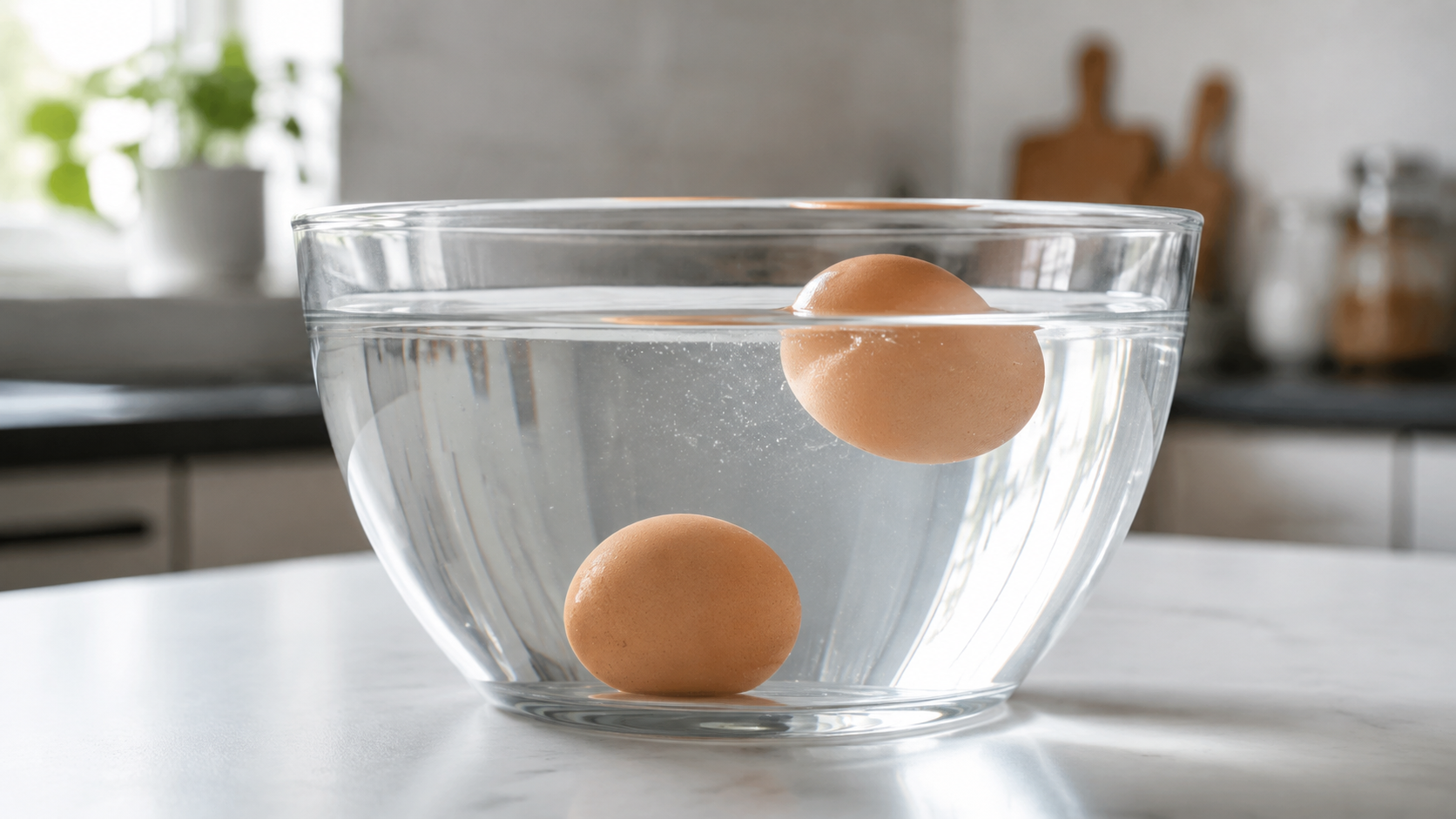
Standfirst: Dropping an egg into water is one of the internet’s favourite kitchen tests. But a floating egg is not automatically rotten—and a sinking one is not guaranteed to be safe.
Dropping a questionable egg into a bowl of water has become one of the most widely shared kitchen tricks online. The usual claim is simple: a fresh egg sinks, while a bad egg floats.
The first half of that rule contains some truth. The second can be dangerously misleading.
The UK Food Standards Agency says the float test measures an egg’s age rather than its safety. It cannot reveal whether harmful bacteria are present. That means an older egg may float without necessarily being unsafe, while an egg that sinks can still carry bacteria capable of causing illness.
So what does the bowl of water actually tell you—and how should you decide whether an egg belongs in the frying pan or the bin?
What the egg float test actually measures
An eggshell looks solid, but it contains thousands of microscopic pores. As an egg ages, it gradually loses moisture and carbon dioxide through those pores while air enters the shell. This enlarges the air cell at the egg’s blunt end and reduces the egg’s overall density.
That change produces the familiar results:
- A very fresh egg normally sinks and lies flat.
- An older egg may remain on the bottom but stand upright.
- A sufficiently old egg may rise and float.
Australia’s national science agency, CSIRO, explains that the enlarged air cell is the main reason stale eggs become buoyant. Fine cracks or a weakened shell can also affect the result, however, so the test is not a precise clock.
In other words, the water is revealing a physical change associated with age. It is not testing for Salmonella or any other microorganism.
Why a sinking egg is not proof that it is safe
Foodborne bacteria do not make an egg noticeably heavier or lighter. They may also be impossible to see or smell.
The US Food and Drug Administration warns that even fresh eggs with clean, uncracked shells can contain Salmonella. This is why a young egg that sinks is not automatically free from contamination.
The opposite is also true. The US Department of Agriculture says a floating egg is of poorer quality because of its enlarged air cell, but it may still be safe. Its age and eating quality should not be confused with evidence of dangerous bacterial growth.
The float test can therefore answer one limited question—“Is this egg probably old?”—but not the more important one: “Is this egg microbiologically safe?”
Are eggs safe after the best-before date?
In the UK, eggs normally carry a best-before date rather than a use-by date. The distinction matters: a best-before date primarily concerns quality, while a use-by date is about safety.
Current Food Standards Agency guidance says eggs can be eaten for a couple of days after their best-before date if they are cooked thoroughly. Both the yolk and the white should be fully cooked, and older eggs can also be used in thoroughly cooked or baked dishes.
That advice is not an unlimited extension. How an egg has been handled and stored still matters, and cracked or badly contaminated eggs require greater caution.
The checks that are more useful at home
No home trick can certify that an egg is free from pathogens, but several checks can help identify obvious spoilage or damage.
First, inspect the shell. Avoid an egg that is cracked, leaking or unusually dirty. A break in the shell can give microorganisms an easier route to the contents.
Next, crack the egg into a clean, separate bowl rather than directly into the rest of a recipe. A spoiled egg usually produces a distinctly unpleasant smell that is obvious once the shell is opened. A pink or iridescent egg white can also indicate bacterial spoilage, according to the USDA, and should be discarded.
A runny white or flatter yolk does not necessarily mean the egg is dangerous. These are common quality changes as an egg ages. Older eggs spread farther in a frying pan and are less suitable for poaching, but age alone does not prove that they will cause illness.
Smell and appearance can expose some types of spoilage; they still cannot detect every food-poisoning organism. Safe storage and appropriate cooking remain more important than any single kitchen test.
Storage makes a bigger difference than the bowl test
The Food Standards Agency advises keeping eggs in a cool, dry place, ideally in the refrigerator, and avoiding extreme temperature changes. Moving eggs repeatedly between warm and cold environments can cause condensation on the shell, increasing the chance that Salmonella on the outside penetrates it.
The FDA recommends that refrigerated eggs be kept in their original carton at 40°F (about 4°C) or below and used within three weeks for best quality. The carton reduces moisture loss and also helps protect the eggs from damage and odours elsewhere in the refrigerator.
Storage rules vary between countries because eggs may be processed differently before sale. Consumers should therefore follow the instructions on the packaging rather than copying storage habits from another country’s social-media video.
What about runny or raw eggs in Britain?
The UK has specific guidance for eggs produced under recognised assurance schemes. The Food Standards Agency says British Lion-marked hen eggs, and eggs produced under the Laid in Britain scheme, may be eaten raw or lightly cooked by most people, including pregnant women, young children, older adults and people with certain underlying health conditions.
The exception includes people who are severely immunocompromised and following a medically supervised diet, such as some transplant patients. The relaxed advice also does not automatically apply to non-hen eggs, imported eggs or eggs without a recognised assurance mark.
The bottom line
An egg floats because it has become less dense as its air cell grows. That makes the test a rough indicator of age—not a reliable test of food safety.
Use the date, storage history and condition of the shell as your first checks. Crack questionable eggs separately, discard anything with an abnormal colour or offensive smell, and follow official cooking guidance. Most importantly, do not assume that a sinking egg is guaranteed safe simply because it passed a viral water test.
